
January 1 to December 31, 2025
In accordance with the NJC Terms of Reference, the undersigned submit this annual report regarding the performance and the administration of the Disability Insurance Plan during the period of January 1 to December 31, 2025.
Chairperson of the Board of Management
Sean Ross
Employer Side Members
- Michel Alarie, Indigenous Services Canada
- Irene Arkorful, Treasury Board of Canada Secretariat
- Stephanie Austin, Treasury Board of Canada Secretariat
- Sharon Bowles, Treasury Board of Canada Secretariat
Bargaining Agent Side Members
- Demi Braniff, Professional Institute of the Public Service of Canada
- James Infantino, Public Service Alliance of Canada
- Stéphanie Rochon Perras, Association of Canadian Financial Officers
- June Winger, Union of National Defence Employees
General Statement
The Disability Insurance Plan Board of Management (the “Board”) is pleased to provide this report on the administration of the Public Service Disability Insurance Plan (the “DI Plan” or “the Plan”), its financial performance and the activities of the Board for the period of January 1 to December 31, 2025.
Plan Overview
The DI Plan provides income replacement for Plan members during periods of long-term disability equal to 70% of insured earnings. Employees who meet the criteria of total disability preventing performance of the duties of their regular employment become eligible for long-term disability insurance benefits at the expiration of the longer of paid sick leave or the 13-week elimination period for the DI Plan. Employees receive income replacement payments as well as disability case management and rehabilitation services from Sun Life Financial (the Insurer). These payments are offset by payments to which employees may be eligible from other disability benefit programs.
The DI Plan is a group insurance policy underwritten and administered by Sun Life Assurance Company of Canada.
Financial and Administrative Oversight
The total benefits paid out by the Plan during 2025 amounted to $539.1 million, compared to $496.3 million in 2024. As of the end of 2025, the DI Plan had 13,854 members utilizing benefits (claims in payment at year-end 2025) and had $4.291 billion in claims reserves. The average number of Plan members during 2025 was 304,000 (down from 312,000 members in 2024).
The disability incidence rate in 2025 was higher than the previous year at 12.9 approved claims per thousand Plan members, compared to 11.3 approved claims per thousand Plan members in 2024. The rate of termination of active claims (approved claims in payment) increased slightly from 2.37 terminated claims per 10 claims in payment in 2024 to 2.39 terminated claims in 2025.
The overall result of the 2025 financial experience for the Plan at year-end was negative, with an in-year loss of $49.6 million. As of December 31, 2025, the balances in the Claims Fluctuation Reserve and the Surplus Account were $195.4 million and $460.5 million respectively for a total Plan surplus of $655.9 million. This is a decrease over the $705.5 million total Plan surplus as of December 31, 2024. Although the Plan experienced a loss in 2025, it is still on a sound financial footing at the end of 2025. The Board, in its role of overseeing the financial management of the Plan, will continue to monitor the trends in plan experience in the coming year.
In addition to overseeing the financial results of the Plan, the Board continued to work actively with the Insurer and Treasury Board of Canada Secretariat, as plan sponsor, to strengthen and improve the effectiveness of the administration of the Plan. Some of the key activities in this area are outlined below.
Member Experience
At its May meeting, the Board was briefed by the Insurer on the results of the annual Claimant Survey conducted in 2024. The results are based on the research methodology which provides a true account of the entire claims experience. Objectives included assessing claimants’ satisfaction with their disability claim experience and identifying areas of improvement. The Board receives the results of the survey annually.
The survey results were compared to those of the previous year, as well as other benchmark groups, representing results from other large clients of the Insurer. The DI Plan Disability Client Index score is an overall measure of the disability claim experience that considers factors such as the ability to make the claim process easy, the ability to proactively reach out during the claim process and the ability to effectively handle any issues during the claim process. DI Claimants’ overall satisfaction with their disability claim experience was slightly below the results of other large Sun Life clients, particularly in areas such as the return-to-work experience (56% versus 67%). Empathy and care in communication were identified as key improvement areas. Issues mentioned related to payment timeliness, communication, and claim decisions. DI Claimants expressed higher satisfaction with how problems were handled compared to other Sun Life clients. The Insurer noted that hiring and onboarding rates of case managers are aligned with demand and attrition. Looking ahead, the Insurer shared their Action Plan, which focused on empathetic communication and mental health training to support those with mental health conditions. Other steps included regular reviews of phone calls to enhance service quality, immediate responses to those that provide very dissatisfied survey responses, and collaboration with the government to address systemic concerns.
Activities
The Board began 2025 with 41 appeals ready to be reviewed and successfully reviewed 34 appeals (compared to beginning with 33 appeals and reviewing 25 in 2024). However, with case volume continuing to remain high, the Board continues to have several outstanding appeals to be heard and has had numerous discussions on how to resolve the backlog of appeals. In the interim, the Board met more frequently and tried to review at least four appeals per meeting.
In 2025, the Board discussed the backlog and possible solutions at length. Following these discussions, an additional Medical Consultant and other ideas were tabled for consideration at the Executive Committee.
The current financial agreement between the Treasury Board of Canada Secretariat and the Insurer stipulates that disability premiums are required during all periods of leave without pay. The Public Service Alliance of Canada representatives on the Board proposed that in cases where employees have alternative disability insurance coverage while on leave without pay, that the required disability insurance premiums be waived. Given that the Board’s role is advisory in nature, it discussed this issue throughout 2025 to determine how it could best be brought to the Executive Committee. The Board determined that highlighting this issue when re-submitting the proposed changes to the provisions of the DI Plan would be the way forward for 2026.
At its annual Sun Life Headquarters’ meeting, the Board received various presentations, including their Retroactive Claims Adjustment Project, disability appeal statistics and litigation performance, and claims submissions and adjudication processes. The Board also received a presentation on the 2024 DI Plan Financial Results as well as the 2025 year-to-date. Highlights of years 2021 to 2025 are presented in the chart below.
It was reported that the overall financial experience of the Plan in 2025 was negative, with an in-year loss of $49.6 million. Of that amount, the interest on the Plan surplus total at the beginning of the year contributed $22.3 million in revenue. The net in-year plan experience (without the surplus) was therefore a loss of $71.9 million. Therefore, the premium level even when combined with the interest of $22.3 million generated from the surplus was insufficient to support the costs incurred by the claims in 2025. This marks a shift from 2022 to 2024, where premiums, excluding surplus interest, were sufficient to cover claims costs, and the first such shortfall since 2021.
Year | Premium Income ($ Million) | Interest Income ($ Million) | Paid Claims* ($ Million) | Total Plan Expenditures* ($ Million) | In-year Gain/Loss ($ Million) |
|---|---|---|---|---|---|
2021 | 597.9 | 94.9 | 380.8 | 680.9 | 11.9 |
2022 | 651.0 | 99.1 | 421.8 | 653.8 | 96.3 |
2023 | 708.5 | 131.4 | 455.0 | 754.4 | 85.5 |
2024 | 777.3 | 146.4 | 496.3 | 897.0 | 26.7 |
2025 | 781.7 | 147.9 | 539.1 | 979.2 | (49.6) |
* Total plan expenditures are calculated as paid claims, expenses and premium taxes, as well as the change in the claims reserves held at the beginning of the year as compared to the end of the year. (Note: The paid claims amount column is included in the total Plan expenditures column. The In-year Gain/Loss equals the Premium and Interest Income minus the Total Plan Expenditures.)
The Board has reviewed the monthly and annual reports received from the Insurer and concluded the current format continues to serve its needs and purposes.
Claims Experience
The 2025 annual report prepared by the Insurer includes a broad overview of Plan claims data. During the 2025 calendar year, there were 5,560 notified claims, an increase of 472 or 9.3%; 3,918 claims were approved, an increase of 385 or 10.9% from the 2024 calendar year. The number of claims declined during the year increased by 486 or 37.9% and the number of claims terminated (closed) during the year increased by 173 or 5.7%. The decline and approval rates are something that the Board will continue to monitor with the Insurer.
| Number of Claims | 2021 | 2022 | 2023 | 2024 | 2025 |
|---|---|---|---|---|---|
| Number of claims notified during the year | 3,906 | 4,365 | 4,627 | 5,088 | 5,560 |
| Number of claims approved during the year | 2,816 | 3,189 | 3,213 | 3,533 | 3,918 |
| Number of declined claims during the year | 830 | 1,331 | 1,178 | 1,284 | 1,770 |
| Number of terminated (closed) claims during the year | 2,759 | 2,897 | 3,058 | 3,053 | 3,226 |
| Total number of approved claims at year-end | 12,188 | 12,512 | 12,694 | 13,165 | 13,854 |
| Total number of pending claims at year-end | 498 | 451 | 647 | 811 | 699 |
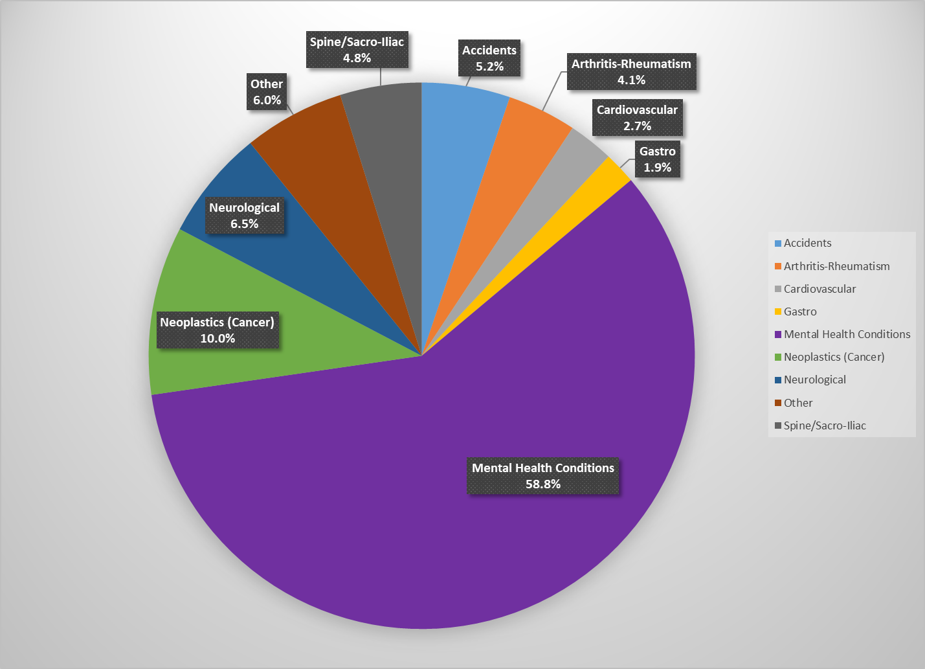
Text version: Distribution (%) of Claims Approved in 2025 by Causes of Disability — Total for Year 2025
Mental health conditions remain the leading cause of new disability claims approved in 2025, a pattern consistent across other Canadian disability plans. The distribution of causes of disability for all new claims approved in 2025 is shown in the chart above. The most frequent cause of new approved claims was mental health conditions (58.8% of the total), a slight decrease from 2024 (59.0%). The actual number of newly approved claims for this cause of disability increased from 2,084 in 2024 to 2,305 in 2025. The increase (+10.6%) is in line with the overall increase (+10.9%) in approved claims in 2025 which explains why the distribution percentage has stayed relatively stable compared to the previous year. Similarly, almost all categories saw their numbers of claims increase in 2025, apart from neoplastics (cancer). Cardiovascular, gastro, and neurological conditions saw particularly notable increases, well above the overall volume of claims increase of 10.9%.
The second largest cause of new disability claims was neoplastics (cancer), which decreased from 11.1% of all approved claims in 2024 to 10.0% in 2025. While neoplastics was the only category to see a decline in raw claim numbers, four categories (neoplastics, mental health conditions, spine/sacro-iliac, and other) saw their proportional share of total claims decrease year over year, as their growth did not keep pace with the overall increase in approved claims.
Appeal Cases
The Board’s terms of reference include the duty to examine appeals against claims declined by the Insurer, making recommendations to the Insurer on these and in certain circumstances providing advice on practices related to disability management in departments and agencies.
As noted previously, the Board reviewed a total of 34 appeal cases in 2025. The Board found no reason to disagree with the Insurer’s decision to deny benefits in 30 appeals and disagreed with the Insurer’s decision in four appeals. In addition to the 34 appeal cases reviewed by the Board, two appeals were closed ahead of being heard at the Board in the absence of medical information for the Board to review between the change of definition date and medical retirement.
The Board requested that the Insurer provide statistics for 2024 on the number of claims that were denied, subsequently appealed, and ultimately referred to the Board. At its March meeting, the Insurer reported that 1,284 claims were denied; of these, 307 were referred to its Appeals Team, and 194 were not overturned on appeal. Of the 2024 declined claims, 20 elected to proceed to the Board; of these, 6 had been received and were awaiting review as of the March 2025 meeting.
Board Membership
The Board met ten times during the period covered by this report, devoting much of its time to hearing appeal cases and overseeing the administration and financial experience of the DI Plan. These meetings consisted of nine half-day sessions and one full-day session.
At the time of production of this report, the members of the Board are:
- Sean Ross, Chairperson
- Sharon Bowles, Treasury Board of Canada Secretariat
- Michel Alarie, Indigenous Services Canada
- Irene Arkorful, Treasury Board of Canada Secretariat
- Stephanie Austin, Treasury Board of Canada Secretariat
- James Infantino, Public Service Alliance of Canada
- Stéphanie Rochon Perras, Association of Canadian Financial Officers
- Demi Braniff, Professional Institute of the Public Service of Canada
- June Winger, Union of National Defence Employees
The Board would like to thank the previous Chairperson, Patti Bordeleau, for her contributions during her two terms, which concluded prior to the production of this report. The Board would also like to thank Employer Side member, Dr. Bryan Garber, who served on the Board for many years.
Conclusion
The Board would like to thank Dr. Raymond Aubin for providing expert medical advice during the review of appeals in their role as Medical Consultant to the Board.
The Board would also like to express its appreciation to the Insurer for its commitment and collaboration in working with the Board. A number of constructive initiatives were undertaken over the year in the interest of supporting and communicating with Plan members and providing the Board with the knowledge and information it needed to fulfil its duties.