
Reimbursement for Business Use of Personal Vehicles
Study prepared for The Treasury Board of Canada Secretariat
By Corporate Fleet Services
1. Fuel Price Update Synopsis
Corporate Fleet Services (CFS) has been mandated by the Treasury Board of Canada Secretariat to perform the annual evaluation of per-kilometre Reimbursement Rates for government employees who are required to use their personal vehicles while performing government business. Furthermore, the periodic impact of varying fuel prices is to be evaluated quarterly by producing three additional Fuel Price Updates per year. The present document represents the Update for February 2026.
The latest annual study established Reimbursement Rates for each Canadian Province and Territory after performing a comprehensive analysis of all vehicle operating expenses. These rates were presented in the Reimbursement for Business Use of Personal Vehicles Report, dated November 2025 (for publication on January 1st, 2026).
The present Update reflects the impact of current fuel prices on the Travel and Commuting Rates’ recommendations made in the Annual Report, with a focus on average pump prices of gasoline by Province and Territory. The prices were averaged for each Province or Territory for the three months prior to the release of the current Update (the months of December 2025, January 2026 and February 2026). All prices are given in dollars per litre.
This Update also presents the latest recommended rates of reimbursement for consideration by the Treasury Board Secretariat in dollars per kilometre. The recommendations for Reimbursement Rates are given for:
- Travel Rates (travellers authorized and reimbursed to use their personal vehicles on government business travel), also referred to as “Kilometric Rates” in the National Joint Council Travel Directive (Appendix B), and
- Commuting Rates (employees reimbursed their variable expenses to use their personal vehicles to commute to their designated remote worksites), also referred to as “Lower Kilometric Rates” in the National Joint Council Commuting Assistance Directive (Appendix A).
Federal and Provincial sales taxes were also researched to determine if there were any recent changes that could have had an immediate impact on the total costs of vehicle ownership and operation.
For the period December 2025 - February 2026, fuel expenses represent 17.8% of the total cost of vehicle operation (reflected in the Travel Rates) or a Canadian weighted average of 10.7 cents per kilometre. The present Update identified slight decreases in average gasoline prices across Canada, which had a minimal impact on both Reimbursement Rates. As a result, the Reimbursement Rates for the ten Provinces decreased by a maximum of 1.0 cent per kilometre relative to the previous Annual Report (November 2025, for publication on January 1st, 2026). Similarly, for the Territories, both Reimbursement Rates also saw a maximum decrease of 1.0 cent per kilometre (see Section 2.2 - Gasoline prices across Canada for details).
2. Fuel Prices
2.1 Energy Market Context
Gasoline prices in Canada declined through December and early January, before moderately recovering towards late January and February, largely reflecting movements in global crude oil markets. In addition, typical seasonal factors like decreased demand, switching to less expensive winter fuel, as well as the end of the fall refinery maintenance season, all contributed to further price reductions at the pump in the last few months.
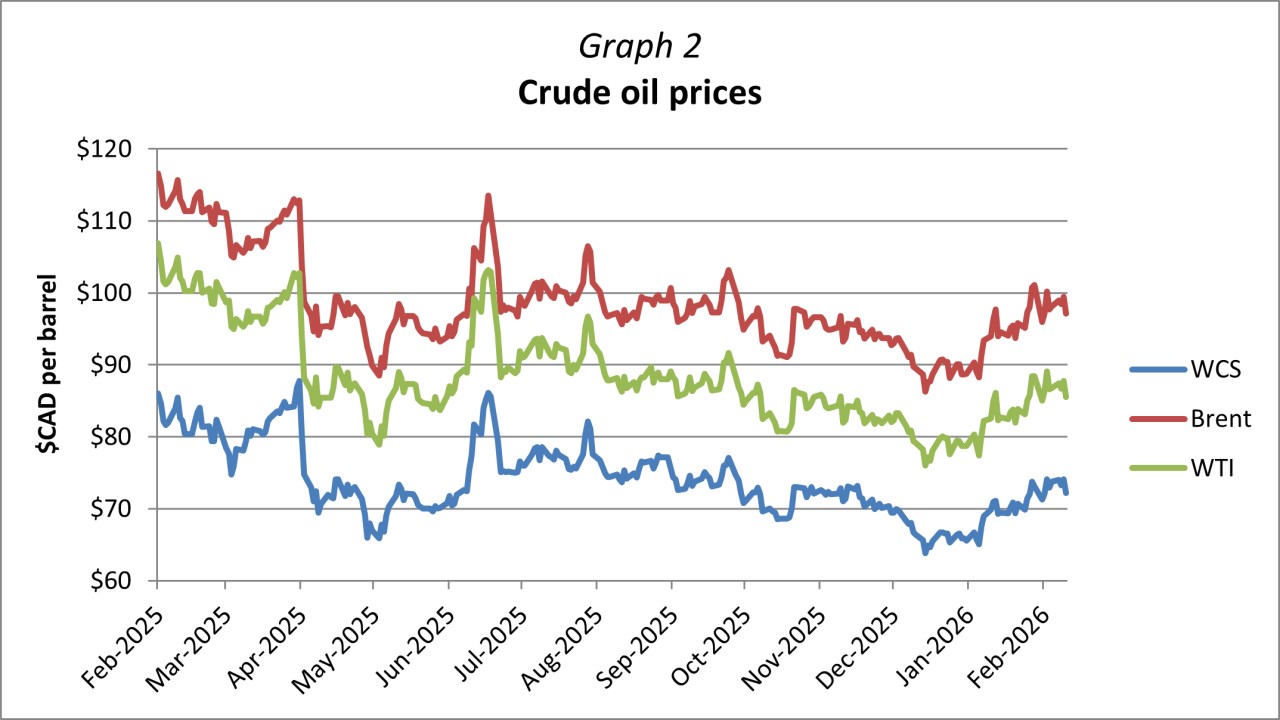
Global crude oil prices were on a steady decline until about mid-December. The three-month low was reached on December 16th when West Texas Intermediate (WTI) closed at $55.27 USD per barrel and Brent at $58.92 USD per barrel. The three-month highest price was reached on January 29th, when WTI reached $65.42 USD per barrel, while Brent was at $70.71 USD per barrel. As of February 13th, WTI stood at $62.89 USD per barrel, and Brent was at $67.75 USD per barrel.
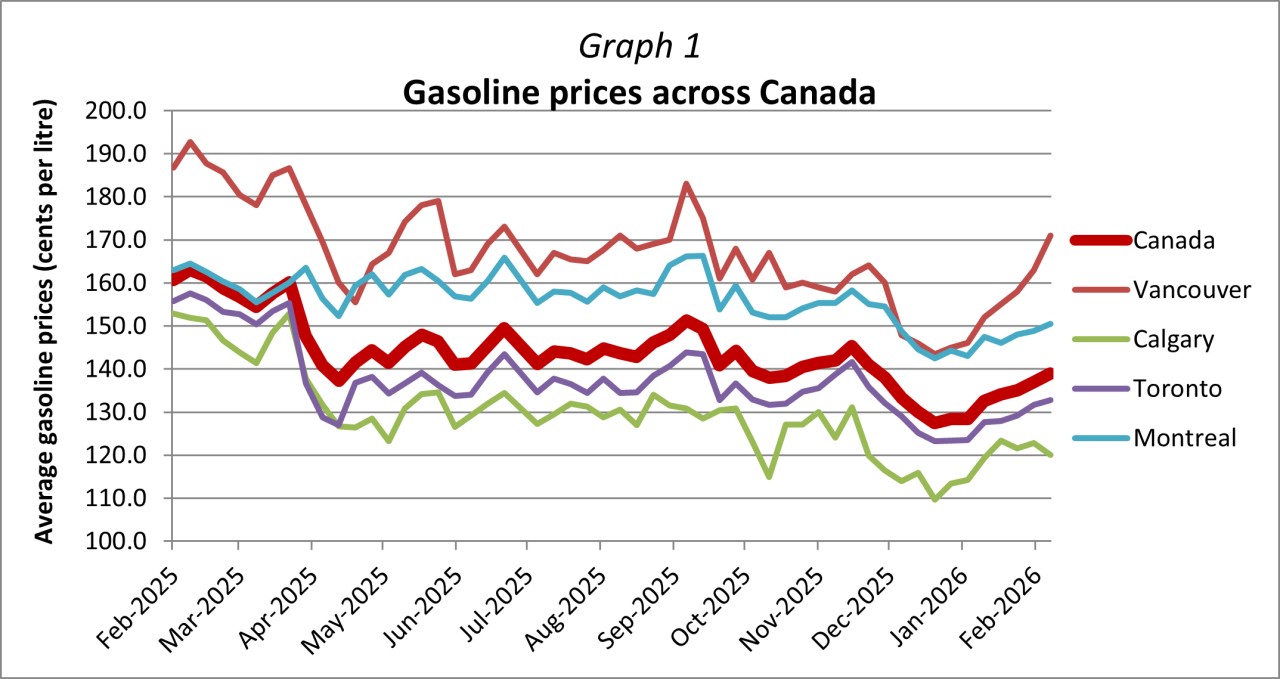
Over the past three months, gasoline prices in Canada followed crude oil trends. The daily price for gasoline in Canada reached its lowest three-month point on December 29th, when the average price was $1.271 per litre. The three-month average price of gasoline was $1.355 per litre, as compared to $1.435 per litre in the previous three-month period from September through November 2025, a decline of 6.5%. From a yearly perspective, the three-month average price in Canada was 13.8% lower than during the same three-month period last year, when the price averaged $1.572 per litre.
2.1.1 Global Crude Oil Demand
Despite expectations of a slowdown in the global economy in the second half of 2025, economic performance proved stronger than anticipated, providing some support for near‑term oil demand. As a result, overall estimates have seen a slight improvement. According to the International Monetary Fund’s (IMF) latest World Economic Outlook (WEO) Update from January 2026, the global economy is expected to grow by 3.3% in 2026 (a 0.2 percentage point improvement as compared to the WEO from October 2025) and 3.2% in 2027. While the surge in technology investments, including artificial intelligence (AI), is providing support to growth projections, it is also largely offset by shifting trade policies. The risks to the outlook remain tilted to the downside. The IMF, as well as the Bank of Canada point to a possible inflated enthusiasm about the artificial intelligence companies that could lead to downward adjustments in the financial markets. The continued uncertainty about the trade policies, as well as the global geopolitical tensions, are all casting clouds over the outlook.
Within this broader global outlook, Advanced Economies as a group are expected to grow by 1.8% this year, an upward adjustment of 0.2 percentage points over the WEO from October 2025. The United States (U.S.) economy has seen a significant 0.3 percentage point improvement and is projected to expand by 2.4% in 2026. This improvement has been largely driven by the pickup in technology investments and expenditures last year, which offset the drag from the federal government shutdown at the end of the year. Lower policy rates are providing further support to the growth with the U.S. Federal Reserve cutting its target rates by 0.25% on December 10th, 2025. In addition, some trade disputes have abated. For example, discussions about the exports of semiconductors and rare earth minerals between China and the US resulted in reduced bilateral tariffs until November 2026. In addition, the U.S. has also removed tariffs on some agricultural products for all countries. As a result, the effective tariff rate for the U.S. is estimated at around 18.5%, an improvement over the 22% back in April of 2025, but still much higher than the 3% rate before the tariff hikes.
The Euro Area economy has also seen an upward adjustment of 0.1 percentage points, with the growth projected at 1.3% for this year and 1.4% the next year. The IMF notes that some technology-related investments contributed to activity in Spain and the United Kingdom, while a boost in aerospace exports lifted growth in France in the second half of last year.
Against this global backdrop, Canada’s economy is continuing to adjust to the new trading landscape shaped by U.S. tariffs and the unpredictability of future trade arrangements. Canadian exports have declined by about 4% as compared to the period prior to the introduction of these trade restrictions. The Bank of Canada notes that businesses affected by the U.S. tariffs are reconfiguring their trade and seeking new suppliers and markets. As this process is taking place, capital is being relocated while workers shift roles, with both factors restraining growth for the time being. As a result, the Bank of Canada, in its Monetary Policy Report (MPR) from January 2026, reports that the Gross Domestic Product (GDP) is estimated to have increased by 1.7% in 2025. When population growth is accounted for, the GDP per capita remained the same. Furthermore, growth is expected to slow down, only increasing by 1.1% in 2026 and 1.5% in 2027, in part due to slower population growth. From a historic perspective, these are modest growth rates. By comparison, the IMF outlook for Canada remains a little more optimistic and robust, noting a slight improvement for 2026, with the GDP expected to expand by 1.6% in 2026 and 1.9% in 2027.
Emerging Markets and Developing Economies are forecast to grow by 4.0% in 2026. China’s economy has continued to be supported through resilient exports, while its domestic demand, especially in the housing sector, remains weak. Overall, China’s outlook has improved by 0.3 percentage points, to 4.5% for 2026, largely supported by the truce reached between the U.S. and China on export agreements. On the other hand, India’s growth remains strong at 6.4% for this year as well as next year.
Despite these improvements, economic uncertainty continues to weigh on global oil consumption expectations. However, forecasts differ on the scale of its impact. According to the Monthly Oil Market Report (MOMR) from February 2026, OPEC projections remain unchanged from three months ago, with global demand increasing by 1.4 million barrels per day (mb/d), to average 106.5 mb/d in 2026. The OPEC forecasts further growth by 1.4 mb/d in 2027. For comparison, the United States Energy Information Administration (U.S. EIA) foresees an increase of 1.2 mb/d this year, to average 104.8 mb/d and an additional 1.3 mb/d in 2027, to average 106.1 mb/d. The U.S. EIA notes that global consumption growth is driven almost entirely by non-OECD countries, which as a group are expected to grow by 1.1 mb/d in 2026 and 1.2 mb/d in 2027. The International Energy Agency (IEA) is more cautious in its projections and has reduced its demand forecast growth to rise by 0.85 mb/d this year, as compared to the 0.93 mb/d estimated the month prior. Similar to the U.S. EIA, the IEA notes that the demand growth comes entirely from non-OECD regions, with China being the largest contributor to growth, with about 0.2 mb/d, which is still below the average growth rate of the past decade.
2.1.2 Global Crude Oil Supply
As highlighted in the Annual Report (November 2025, for publication on January 1st, 2026), production growth has remained robust despite moderate demand, resulting in persistent oversupply conditions. Inventories are continuing to increase, pushing the price of oil down. In January, temporary factors, including a winter storm in North America as well as geopolitical tensions in the Middle East, led to price increases and a rise in volatility. As a result, oil prices rose steadily by roughly $10 USD per barrel during January. This upward shift, however, is not expected to persist in the long term, as fundamentals remain bearish.
Global crude oil inventories continue to rise. The U.S. EIA estimates stand at an average of 3.1 million barrels per day (mb/d) in 2026 (an increase from an average of 2.7 mb/d in 2025). The projections show OECD inventories ending 2025 at about 2,883 million barrels and potentially climbing to 3,107 million barrels by the end of 2026, with the United States accounting for a significant share.
Overall, according to the U.S. EIA, global crude oil production is set to rise steadily from 106.3 mb/d in 2025 to 107.9 mb/d in 2026, before further increasing to 108.8 mb/d in 2027. For comparison, the International Energy Agency (IEA) estimates global production could average as high as 108.6 mb/d in 2026, increasing by 2.4 mb/d year-over-year, with growth split relatively evenly between OPEC+ and non-OPEC+ producers, assuming current production agreements remain in place. This persistent expansion has exceeded demand growth, creating an oversupplied market and placing downward pressure on prices. The IEA projects that global supply could exceed demand by 3.73 mb/d in 2026, equivalent to nearly 4% of global demand and larger than many other forecasts.
During January 2026, however, several temporary disruptions interrupted this broader trend and temporarily tightened supply, providing upward momentum for oil prices. Extreme winter weather across North America forced significant production shut-ins. A major winter storm caused U.S. producers to lose up to 2 mb/d (roughly 15% of national output) over a single weekend, while freezing conditions also reduced refinery throughput along the coast of the Gulf of Mexico. The U.S. EIA estimates that cold weather reduced U.S. output by around 0.32 mb/d in January. At the same time, disruptions in Kazakhstan cut production by more than 0.4 mb/d. These events, combined with outages and export constraints affecting Russian and Venezuelan flows, contributed to a 1.2 mb/d decline in global supply in January, according to the IEA estimates.
The role of OPEC+ actions in the global energy market balance remains important. The alliance, which had begun increasing output in April 2025 after years of production cuts, has continued to influence the supply landscape even as it paused further production increases starting in January 2026, a move that is expected to last through at least March. Despite this pause, OPEC+ output remains elevated, averaging 43.3 mb/d in January. This is above the estimated demand for OPEC+ crude, which stood near 39.7 mb/d in the first quarter, further exacerbating the oversupply conditions.
The United States (U.S.) also remains a major driver of global production growth. U.S. output reached record highs in 2025 of 13.6 mb/d, and the country has remained a net energy exporter since 2019. Even as rig deployments fell by about 15% last year amid lower prices and uncertainty, production declined only slightly before rebounding to record levels due to advances in drilling and fracking technology. However, analysts warn that sustained oil prices below $60 USD per barrel could discourage investment, particularly given the rapid decline rates of shale wells, many of which produce around 80% of their total output within the first two years and thus require new investments regularly. The U.S. EIA currently expects U.S. production to remain flat at around 13.6 mb/d in 2026, before declining modestly to 13.3 mb/d in 2027.
Canada also remains among the countries that continue to increase production. Canada is expanding its export capacity following the opening of the expanded Trans Mountain Pipeline in 2024, enabling oil sands producers to access Asian markets more easily. Canadian oil exports reached 4.44 mb/d in November 2025, up 5.5% year-over-year, with exports to Asia rising threefold in a year, to a record 0.68 mb/d. While the U.S. remains the main destination of Canadian crude, with 3.76 mb/d or 84.7%, this marks a decline from 3.97 mb/d in November 2024. Furthermore, Trans Mountain has plans to further expand its system by 0.3 mb/d, with the first increase of 0.1 mb/d coming as early as January 2027. The latest data indicates that Alberta’s production increased from 4.2 mb/d in November 2024 to 4.4 mb/d in November 2025, reinforcing Canada’s growing contribution to global supply.
Overall, the past three months have been characterized by a divergence between short‑term price movements and longer‑term market fundamentals. While winter storms, geopolitical tensions, and temporary outages supported prices in January, underlying fundamentals continue to point toward expanding supply, rising inventories, and persistent downward pressure on crude prices.
2.2 Gasoline Prices Across Canada
Over the past three months, average gasoline prices in Canada have declined, broadly tracking movements in crude benchmarks. Because crude oil prices remain the primary driver, the decline has been quite consistent across Canadian provinces, with only slight fluctuations. The refining margins (which can be broadly interpreted as refining profits) remained higher than a year ago, by about 10 cents per litre, mainly due to tighter refining capacity and smaller inventories of refined products. The Eastern Provinces, including Ontario and Quebec, rely on imported oil and a small number of refineries for their supply, and therefore any disruptions, even minor ones, have a direct effect on the market. As a result, these provinces have seen slightly smaller price declines than the rest of the country, where the gasoline price is more tightly correlated to the price of crude that is locally extracted and refined, thus reducing costs. As a result, the smallest declines have been recorded in Nunavut, at 2.0%, Prince Edward Island, at 3.7%, and Ontario, at 4.3%. The largest declines have been observed in the Prairies and Western Canada, where prices declined by 8.7% in Saskatchewan, 7.9% in Manitoba, 7.4% in Alberta and 6.7% in British Columbia.
Prices of gasoline in Canada include all applicable taxes. Prices vary significantly across Canada, mainly due to the difference in the types and amounts of taxes being charged on fuel in different Provinces and Territories. The present Update calculated the average prices of regular gasoline charged at the pump. The fuel price data was primarily obtained from Natural Resources Canada via Kalibrate (previously Kent Marketing), based on daily published fuel prices for 78 locations across Canada. This data was verified against additional databases that similarly track fuel prices all across Canada.
Consistent with the methodology of the Annual Report, when determining average gasoline prices per Province or Territory, we have used weighted averages according to population in order to better conform to reality. In this manner, metropolitan population centers account for a greater portion of the total average price compared to smaller towns.
The following is a table with average regular gasoline prices for all Canadian Provinces and Territories, in dollars per litre, for the period December 2025 - February 2026:
|
Province/Territory |
Current average fuel price |
January 1st, 2026, Annual Report fuel price |
Price difference |
|
Alberta |
$1.191 |
$1.285 |
-$0.094 |
|
British Columbia |
$1.522 |
$1.632 |
-$0.110 |
|
Manitoba |
$1.218 |
$1.322 |
-$0.104 |
|
New Brunswick |
$1.375 |
$1.455 |
-$0.080 |
|
Newfoundland and Labrador |
$1.451 |
$1.526 |
-$0.075 |
|
Northwest Territories |
$1.378 |
$1.455 |
-$0.077 |
|
Nova Scotia |
$1.351 |
$1.435 |
-$0.084 |
|
Nunavut |
$1.542 |
$1.573 |
-$0.031 |
|
Ontario |
$1.290 |
$1.348 |
-$0.058 |
|
Prince Edward Island |
$1.437 |
$1.492 |
-$0.055 |
|
Quebec |
$1.473 |
$1.557 |
-$0.084 |
|
Saskatchewan |
$1.227 |
$1.344 |
-$0.117 |
|
Yukon |
$1.494 |
$1.596 |
-$0.102 |
Fuel price data was extracted for a period of three months (November 10th, 2025, to February 13th, 2026) in order to reflect current gasoline price trends. Subsequent reports will focus on three-month periods following the period covered in the present study. Average gasoline prices per litre and per Province or Territory were found to vary between $1.191 in Alberta to $1.542 in Nunavut, with a Canadian average of $1.355, a decrease of 8.0 cents from the previous Annual Report (November 2025, for publication on January 1st, 2026).
For illustration purposes, Graph 1 displays gasoline prices for the main metropolitan areas for a one-year period (February 2025 - February 2026).
Also for illustration purposes, Graph 2 displays crude oil prices for three benchmarks – WTI (West Texas Intermediate), Brent and WCS (Western Canadian Select) for a one-year period (February 2025 - February 2026).
2.3 Sales Taxes
For the current Update, research was performed to see if there were any relevant changes to Federal and Provincial sales taxes that could have an immediate impact on the Reimbursement Rates. As of the date of this Update, no changes were observed in sales taxes anywhere in Canada as compared to the previous Annual Report.
3. Impact of Fuel Prices on Reimbursement Rates
3.1 Fuel Consumption
In calculating the fuel costs contribution to the total vehicle operating costs, the methodology employed in the Annual Report was strictly adhered to. Fuel consumption for every vehicle model in the study was thus combined with average prices per Province or Territory to determine the fuel portion of operating costs, based on an average of 20,000 kilometres per year.
3.2 Updated Reimbursement Rates
For comparison, the following table provides updated Travel (Kilometric) and Commuting (Lower Kilometric) Rates, as well as rates previously calculated for the Annual Report (November 2025, for publication on January 1st, 2026):
Current Reimbursement Schedule (in dollars per kilometre)
|
Travel Rate |
Commuting Rate |
|||
|
Province/Territory |
Current Fuel |
January 1st, 2026, |
Current Fuel |
January 1st, 2026, |
|
Alberta |
$0.560 |
$0.565 |
$0.210 |
$0.220 |
|
British Columbia |
$0.595 |
$0.600 |
$0.255 |
$0.260 |
|
Manitoba |
$0.555 |
$0.565 |
$0.220 |
$0.230 |
|
New Brunswick |
$0.605 |
$0.610 |
$0.235 |
$0.240 |
|
Newfoundland and Labrador |
$0.615 |
$0.620 |
$0.240 |
$0.250 |
|
Northwest Territories |
$0.695 |
$0.700 |
$0.295 |
$0.305 |
|
Nova Scotia |
$0.600 |
$0.610 |
$0.235 |
$0.240 |
|
Nunavut |
$0.700 |
$0.705 |
$0.315 |
$0.320 |
|
Ontario |
$0.625 |
$0.630 |
$0.225 |
$0.230 |
|
Prince Edward Island |
$0.595 |
$0.600 |
$0.240 |
$0.245 |
|
Quebec |
$0.615 |
$0.625 |
$0.255 |
$0.260 |
|
Saskatchewan |
$0.550 |
$0.560 |
$0.220 |
$0.230 |
|
Yukon |
$0.690 |
$0.700 |
$0.310 |
$0.320 |
Note: All figures were rounded up to the nearest half-cent.
The impact of gasoline prices on the Reimbursement Rates was minimal for the present Fuel Update. In comparison with the Annual Report (November 2025, for publication on January 1st, 2026), the Travel (Kilometric) and Commuting (Lower Kilometric) Rates have decreased by a maximum of 1.0 cent per kilometre for the Provinces. For the Territories, the Reimbursement Rates similarly decreased by a maximum of 1.0 cent per kilometre for both the Travel and Commuting Rates.
Overall, Canadian weighted averages decreased by 0.5 cents per kilometre for both the Travel and Commuting Rates, compared to the last Annual Report (November 2025, for publication on January 1st, 2026). They are now at 60.5 cents per kilometre and 23.5 cents per kilometre, respectively.
Fuel contributes on average 10.7 cents per kilometre to total operating costs, ranging from 9.4 cents in Alberta to 17.1 cents in Nunavut. Given the complexity of socio-economic factors affecting the global energy market, it is difficult to make any prediction regarding gasoline prices for the next three-month period. However, any future changes will be reflected in the next Fuel Update.