Dental Care Plan Board of Management (NJC Part)
In accordance with the Dental Care Plan Board of Management (NJC part) Terms of Reference, the undersigned submit this annual report regarding the performance and the management of the Dental Care Plan (NJC Part) during the period of January 1 to December 31, 2025.
Martin Chartier, Chairperson of the Board of Management
Employer Side Members
- Krista Apse, Crown-Indigenous Relations and Northern Affairs Canada
- Philippe Blanchette, Financial Transactions and Reports Analysis Centre of Canada
- Noreen Majeed, Military Police Complaints Commission of Canada
- Jane Manuel, Treasury Board of Canada Secretariat
Bargaining Agent Side Members
- Mathieu Delorme, Association of Canadian Financial Officers
- Celyn Dufay, Professional Institute of the Public Service of Canada
- Mireille Vallière, Canadian Association of Professional Employees
General Statement
The Dental Care Plan Board of Management (NJC Part) (the Board) is pleased to present this report for the period of January 1 to December 31, 2025. The Public Service Dental Care Plan (PSDCP or the Plan) completed 38 years of operation on March 1, 2025.
The Plan is intended to cover reasonable and customary dental treatment necessary to prevent or correct dental disease or defect, provided the treatment is consistent with generally accepted dental practices. The Plan is private, and its cost is fully paid by the Treasury Board of Canada Secretariat (TBS), the Employer.
The Board is composed of management and union representatives. It is responsible for the overall administration of the Plan, balancing the needs of Plan members within the allocated funding, resolving members’ complaints regarding eligibility or claims disputes, monitoring the claims settlement performance of the Administrator (Canada Life), and recommending changes to the Plan.
Administration
The Administrator had an average claim turnaround time of 0.72 calendar days, slightly lower than their 2024 time of 0.80 calendar days. The contact volume statistics for 2025 showed there were 258,527 enquiries, with 183,411 telephone calls, 20,240 chats and 54,876 emails. Out of the 183,411 telephone calls, there were 145,551 English and 37,860 French.
Regarding service level standards during 2025, the Administrator exceeded their target of 70%, answering 96.64% of calls within 20 seconds. Additionally, the average abandon rate for 2025 was 0.30%, compared to 1.35% in 2024. Regarding first call resolution, the Administrator was above the 85% target, sitting at 96.90%.
The Administrator continued to provide data on what percentage of claims are submitted by Plan members versus the service providers. It was noted that in 2025, 90.29% of claims were submitted by the service providers and only 9.71% of claims were submitted by members themselves.
As a part of the Board’s duties, it is responsible for the overall administration of the Plan and monitoring the claims settlement performance of the Administrator. Implementation of the new PSDCP contract has enabled stronger reporting capabilities. Canada Life will continue to report on scaling for children in its annual reports to all components.
The Administrator launched a newly improved website, titled My Canada Life at Work in 2023, which showed that as of Q4-2023, 72.32% of Plan members had registered for the new website. As of Q4-2025, 90.70% of members have registered and 68.0% of those registered have signed up for direct deposit.
Activities
The Board met five times, via virtual and hybrid meeting formats, devoting its time to overseeing the administration and financial status of the Plan, resolving appeal cases, members’ complaints regarding eligibility and claims disputes, and recommending improvements to the Plan. The Board reviewed 8 appeals; this is a decrease of 42.8% from 2024. Of these appeals, four were approved, three were denied, and one was deferred pending additional information from the provider.
There could be several factors contributing to the reduced number of appeals. Plan members are expected to submit appeals directly to Canada Life before escalating to the Board. The new PSDCP Annual Communiqués, with the second issue released in fall 2025, provide members with clearer direction on plan provisions. Targeted communications through the bi-monthly compensation newsletter and email notifications, with content informed by the Board’s feedback, overall appeal trends across all components, and Canada Life’s call centre experience, have also played a role. Finally, improved member self-service through My Canada Life at Work gives members ready access to current eligibility and frequency information, claim status, and estimate reviews.
The Board continued to support the attendance of informal observers on an ad-hoc basis as proposed by both the Employer and Bargaining Agent sides.
The Plan review was done throughout 2024 with the new contract coming into effect November 1, 2024, and improvements and changes to the Plan implemented January 1, 2025. With only eight appeals heard during the reporting period, drawing broad conclusions from trends remains limited. That said, a recurring theme involved coverage for dependent children with disabilities, and the volume of such appeals appears to be increasing into 2026.
Training
When possible, the Board participates in conferences and learning sessions held by the International Foundation of Employee Benefit Plans (IFEBP) as a means to develop Board member expertise and to stay current with trends in employee benefits, including dental. The Board remains committed to investing in the development of its members. Various Board members were able to attend three conferences in 2025: the Legal and Legislative Update, the Canadian Public Sector Pension and Benefits Conference and the 58th Annual Canadian Benefits Conference. To provide the most benefit to all Board members, those who attend provide the Board with a debrief of the conference upon their return.
Plan Expenditures
The total cost of the Plan (NJC Part) since 2020 is as follows:
Year | Total Cost |
|---|---|
2020 | $112.2 M |
2021 | $153.8 M |
2022 | $168.1 M |
2023 | $184.8 M |
2024 | $213.0 M |
2025 | $237.3 M |
The Plan’s costs increased in 2021, 2022, 2023 and 2024 by 37.1%, 9.3%, 9.9% and 15.3% respectively. In 2025, the costs increased by 11.4% over 2024 or 28.4% over 2023.
The total cost of $237.3M for 2025 includes $221.3M or 93.3% for paid claims and $16.0M or 6.7% for expenses. The year-to-year changes are:
Year | Year-Over-Year Change |
|---|---|
2020 | (18.1%) |
2021 | 37.1% |
2022 | 9.3% |
2023 | 9.9% |
2024 | 15.3% |
2025 | 11.4% |
Paid Claims and Employees Covered (NJC Part)
The number of covered employees at the end of 2025 was 178,273, of which a total of 150,772 employees (84.6%) submitted at least one claim, either for themselves or an eligible dependant.
In 2025, we recorded a total of 2,303,838 paid claims, with an average amount paid of $96 per claim. The average benefit per member in 2025 increased to $1,466.37 from $1,323.73 in 2024, which represents an increase of 10.7%.
Out of these 2,303,838 paid claims, 6.86% were submitted via paper by members, 85.04% were submitted digitally by the provider and 8.10% were submitted online by the member.
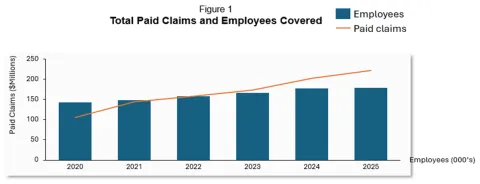
Accessible Data - Figure 1: Total Paid Claims and Employees Covered
| Year | Employees Covered (000s) | Paid Claims ($M) |
|---|---|---|
| 2020 | 141.8 (est.) | 105.0 |
| 2021 | 147.1 (est.) | 144.2 |
| 2022 | 156.8 (est.) | 157.1 |
| 2023 | 165.4 (est.) | 172.8 |
| 2024 | 176.1 (est.) | 201.3 |
| 2025 | 178.3 | 221.1 |
For 2025, the total amount charged by dentists to Plan members was $396,254,977 compared to $221,087,861 in net benefits paid to employees, for a reimbursement ratio of 55.8% (see Table 1).
Year | Routine ($) | Routine (%) | Major ($) | Major (%) | Ortho Amount ($) | Ortho (%) | Total Amount ($) |
|---|---|---|---|---|---|---|---|
2020 | 84,406,432 | 80.4 | 9,522,652 | 9.1 | 11,047,849 | 10.5 | 104,976,933 |
2021 | 115,629,048 | 80.2 | 13,104,366 | 9.1 | 15,429,241 | 10.7 | 144,162,655 |
2022 | 126,353,081 | 80.4 | 13,838,140 | 8.8 | 16,892,862 | 10.8 | 157,084,083 |
2023 | 143,380,811 | 83.0 | 12,976,688 | 7.5 | 16,467,701 | 9.5 | 172,825,200 |
2024 | 165,265,020 | 82.1 | 16,506,372 | 8.2 | 19,525,831 | 9.7 | 201,297,223 |
2025 | 178,289,523 | 80.6 | 18,707,922 | 8.5 | 24,090,417 | 10.9 | 221,087,861 |
Variations between years 2020 and 2025, concerning paid claims by type of treatment, are as follows:
| Treatment | 2020 (%) | 2021 (%) | 2022 (%) | 2023 (%) | 2024 (%) | 2025 (%) |
|---|---|---|---|---|---|---|
| Major Restorative | 5.81 | 5.78 | 5.34 | 4.68 | 5.12 | 5.1 |
| Minor Restorative | 20.75 | 20.52 | 20.00 | 20.38 | 19.90 | 19.1 |
| Oral Surgery | 5.65 | 5.91 | 5.68 | 5.55 | 5.86 | 5.8 |
| Orthodontic | 10.52 | 10.70 | 10.75 | 9.54 | 9.70 | 10.9 |
| Periodontic | 24.11 | 24.97 | 25.50 | 26.57 | 26.60 | 7.0** |
| Preventive | 10.86 | 10.47 | 10.89 | 11.36 | 10.85 | 29.7** |
| Adjunctive | 1.49 | 1.58 | 1.57 | 1.49 | 1.55 | 1.8 |
| Reline / Rebase | 0.02 | 0.02 | 0.02 | 0.01 | 0.01 | 0.0 |
| Dentures / Fixed Bridges* | 1.53/1.73 | 1.62/1.39 | 1.61/1.86 | 1.30/1.53 | 1.78/1.35 | 1.3*** |
| Diagnostic | 13.93 | 13.59 | 13.92 | 14.68 | 14.44 | 14.6 |
| Endodontic | 3.60 | 3.15 | 2.86 | 2.91 | 2.84 | 2.7 |
| Implants | n/a | n/a | n/a | n/a | n/a | 2.0*** |
| Total | 100 | 100 | 100 | 100 | 100 | 100 |
* Dentures and Fixed Bridges have been merged into one reporting category.
** Services included within these sub-categories have been updated as part of the new contract reporting solution.
*** Implants have been added as a new sub-category under the new contract.
Table 2 (above) reflects general stability from 2020 to 2025; adjustments to reporting categories in 2025 will allow for more consistent comparisons going forward.
Figure 2 (below) represents the average amount paid by the Administrator to employees in 2025 in the various age groups.
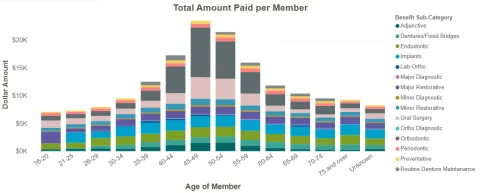
Accessible Data - Figure 2: Total Amount Paid per Member by Age Group
Age Group | Total Amount Paid per Member ($) |
|---|---|
16–20 | 4,600 (est.) |
21–25 | 7,300 (est.) |
26–29 | 7,900 (est.) |
30–34 | 9,400 (est.) |
35–39 | 12,500 (est.) |
40–44 | 17,200 (est.) |
45–49 | 23,500 (est.) |
50–54 | 21,400 (est.) |
55–59 | 15,800 (est.) |
60–64 | 11,900 (est.) |
65–69 | 10,600 (est.) |
70–74 | 9,600 (est.) |
75 and over | 9,400 (est.) |
Unknown | 8,400 (est.) |
Figure 3 (below) shows the average amount paid per service for 2025. Following the new PSDCP contract with Canada Life, more robust reporting is available making comparisons with prior years challenging as new reporting is implemented.
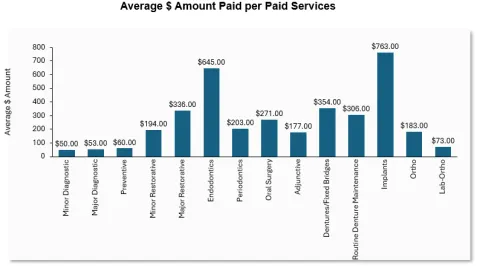
Accessible Data - Figure 3: Average Dollar Amount Paid Per Paid Services
Service | Average Amount Paid ($) |
|---|---|
Minor Diagnostic | 50.00 |
Major Diagnostic | 53.00 |
Preventive | 60.00 |
Minor Restorative | 194.00 |
Major Restorative | 336.00 |
Endodontics | 645.00 |
Periodontics | 203.00 |
Oral Surgery | 271.00 |
Adjunctive | 177.00 |
Dentures/Fixed Bridges | 354.00 |
Routine Denture Maintenance | 306.00 |
Implants | 763.00 |
Ortho | 183.00 |
Lab-Ortho | 73.00 |
Figure 4 (below) shows steady year-over-year growth in both member and dependent claims, which have remained within 3% of each other in most years. The exception was 2023, when member paid claims ran 7% above dependent claims. Throughout the year, the Board monitors the performance of the Plan and the level of service provided to the Plan members.
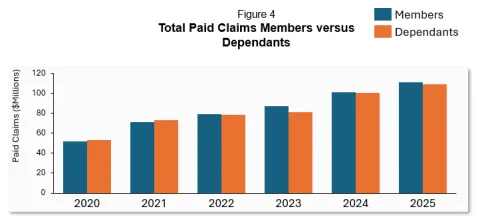
Accessible Data - FIgure 4: Total Paid Claims Members Versus Dependents
Year | Members ($M) | Dependants ($M) |
|---|---|---|
2020 | 51.8 (est.) | 53.2 (est.) |
2021 | 71.1 (est.) | 73.1 (est.) |
2022 | 78.9 (est.) | 78.2 (est.) |
2023 | 89.5 (est.) | 83.3 (est.) |
2024 | 101.0 (est.) | 100.3 (est.) |
2025 | 111.6 (est.) | 109.5 (est.) |
Note: yearly totals above (Members + Dependants) are exact, sourced from Table 1. The split between the two series is estimated from the chart.
For 2025, the performance (Table 3 and 4, below) was as follows (see Note 1):
Measure | Detail | Target | Result |
|---|---|---|---|
| Calls answered in 20 seconds or less | — | 70% | 97.60% |
| Wait time for calls | — | 20 seconds or less | 7 seconds |
| Claims turnaround time | Paper | 90% processed within 7 business days | 98.7% |
| Claims turnaround time | Member Digital | 95% processed within 5 business days | 99.0% |
| Claims turnaround time | Provider Digital | 95% processed within 2 business days | 97.2% |
| Abandon rate | — | 3% of total calls or less | 0.30% of total calls |
| Measure | English | French |
|---|---|---|
| Calls answered in 20 seconds or less | 98.18% | 95.51% |
| Wait time for calls | 6 seconds | 10 seconds |
| Abandon rate | 0.28% | 0.35% |
Note 1: The call centre performance is based on the results for the dedicated line only.
In 2025, the Plan exceeded all established service performance targets. Call responsiveness remained high with very low abandonment rates on both English and French lines, with the English line achieving slightly faster response times. Claim turnaround times surpassed standards across all submission channels, supported by strong digital adoption. Currently, there are 161,737 (90.7%) NJC members registered for member portal access. Of those registered for member portal access, 121,247 NJC members (68.0%), have elected for direct deposit. In 2025, 91.04% of total claims resolved for the PSDCP were submitted electronically.
Figure 5 (below) denotes the Plan’s operating expenses from the previous contract for 2025.
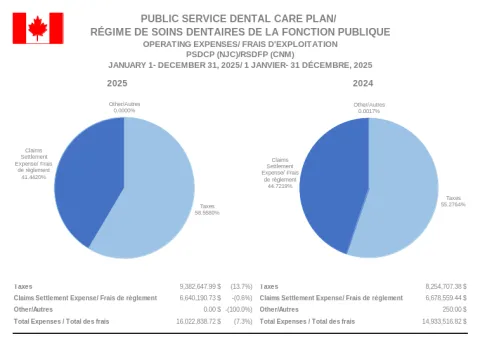
Figure 5: Public Service Dental Care Plan, Operating Expenses
Category | 2025 Amount | 2025 Share of Total | Year-over-Year Change | 2024 Amount | 2024 Share of Total |
|---|---|---|---|---|---|
Taxes | $9,382,647.99 | 58.56% | +13.7% | $8,254,707.38 | 55.28% |
Claims Settlement Expense | $6,640,190.73 | 41.44% | -0.6% | $6,678,559.44 | 44.72% |
Other | $0.00 | 0.00% | -100.0% | $250.00 | 0.0017% |
Total Expenses | $16,022,838.72 | 100% | +7.3% | $14,933,516.82 | 100% |
Communication
Plan members who subscribed to the Compensation and Email Notification System continued to receive bi-monthly emails from TBS throughout 2025 to provide information and reminders regarding the Plan. When the Board notices trends in appeals, they provide TBS with suggestions on what information could be sent out to Plan members to assist them.
The emails that were sent out through the Compensation and Email Notification System in 2025 were as follows:
- The email notification in February 2025 introduced the first edition of the PSDCP annual Communiqué, covering plan improvements and changes to dental care, positive enrolment, and the new PSDCP Member Booklet. It also addressed plan improvements that came into effect January 1, 2025, changing dental providers, and overaged dependant children with a disability.
- The email notification in May 2025 covered the Canada Life Audit Program, pre-determinations for dental services over $300, reminders to use the new PSDCP benefit card, avoiding claim delays with Canada Life, and submitting claims for services received outside Canada.
- The email notification in July 2025 addressed student eligibility during academic breaks and completing positive enrolment.
- The email notification in September 2025 provided information on planning orthodontic treatment in light of the plan increase, and encouraged members to go digital through the Canada Life Member Services Website.
- The email notification in November 2025 reminded Plan members of the PSDCP Communiqué issued with a summary of themes, keeping the Pay Centre updated on personal changes, where to find current information on health and dental coverage including frequency and remaining balances, the streamlined overaged dependant with a disability application form now covering the Pensioners’ Dental Services Plan (PDSP), PSDCP, and Public Service Health Care Plan (PSHCP), the launch of multi-factor authentication, and proposed changes to the PDSP eligibility period.
Conclusion
In closing, the Board wishes to take this opportunity to thank the Administrator, Canada Life, for their contribution to the administration of the Plan in the year 2025. As always, the Board is pleased to oversee and provide advice on the management of this important employee benefit.